
If the cables are damaged during pulling, connectivity isn’t terminated properly, cables are manufactured incorrectly or the environment isn’t conducive to desired network performance, the cable may not perform as expected. For this reason, it’s crucial to make sure cabling and components pass certain parameters after installation is complete.
Cable testing verifies that the installation work was performed to required standards, no damage has occurred and all connectivity is terminated properly to provide the performance you expect. If problems are found, they can be fixed early to prevent issues with unexpected downtime and frustration.
ANSI/TIA-568C.2 is the current standard that cable should be tested to – it describes all elements of a structured cabling infrastructure, including requirements for cables, permanent links, connectors, hardware and patch cords. ANSI/TIA-568C.2 is currently being modified to include all current addendums, including Category 8 cable. The next version, which will be released in late 2018, will be called ANSI/TIA-568.2-D.
The updated version will also include a normative Annex F – Modular Plug Terminated Link, which performance can be measured and compared to for modular plug terminated links (MPTLs) – also known as Direct Connect. This connection method simplifies LAN infrastructure by allowing plugs to be placed at the ends of horizontal cabling and run straight to IP devices.
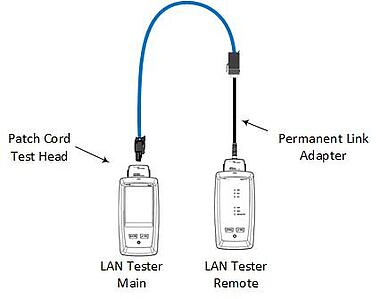
MPTLs are tested as jack to plug, and meet all requirements of a permanent link. Proper testing requires a permanent link adapter and patch cord test head. Below are methods for testing MPTLs and permanent link configurations. Each is accompanied by a figure that represents the testing topology.
Jack-to-Jack Tests
Requirements:
- Main and remote field testers
- Permanent link adapters (x2)
- Actual permanent link being tested

There are four steps to follow during jack-to-jack tests:
- Install the tester and remote unit on both sides of the permanent link
- Select the cable type to be tested
- Select the “permanent link” limit with the appropriate category and standards
- Test all permanent links
Plug-to-Jack Tests
Requirements:
- Main and remote field testers
- Permanent link adapter
- Patch cord test head
- Actual permanent link being tested
There are four steps to follow during plug-to-jack tests:
- Install the tester and remote unit on both sides of the permanent link
- Select the cable type to be tested
- Select the “MPTL” limit with the appropriate category and standards
- Test all permanent links
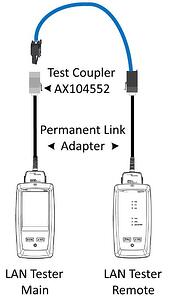
Plug-to-Jack Tests (Belden Alternative)
<pRequirements:- Main and remote field testers
- Permanent link adapters (x2)
- Belden coupler test adapter AX104552
- Actual permanent link being tested
There are four steps to follow during plug-to-jack tests:
- Install the tester and remote unit on both sides of the permanent link
- Select the cable type to be tested
- Select the “permanent link” limit with the appropriate category and standards
- Test all permanent links
REVConnect Testing
The Belden REVConnect Connectivity System is a form of Direct Connect, which allows contractors to terminate a jack or plug onto the same universal core interface; its universal wiring manager supports Category 5e, 6 and 6A cables. It allows field-terminable plugs used to support Category 6A and PoE applications to be terminated just as easily as a jack.
With REVConnect, a single termination process works for every application. You can switch from a jack to a plug or vice versa without having to re-terminate. Learn more here.
À propos de l’auteur
Ron Tellas
Architecte de solutions, Solutions d’entreprise, Belden
Ron Tellas est un expert en matière de conception des radiofréquences et de propagation électromagnétique, et a rejoint Belden en 2016 pour aider à définir la feuille de route de la technologie et des applications dans le bâtiment intelligent. Il met maintenant à profit sa vaste expérience pour intégrer des systèmes, des équipements et de la connectivité dans des solutions réseau. Ron représente Belden dans plusieurs organismes de normalisation et comités du National Electrical Code, et en tant que membre du conseil d’administration de la FMP Alliance. Il est titulaire d’un master et d’une licence en génie électrique et d’un master en administration des affaires, et est l’inventeur de 17 brevets américains. Ron est fier d'avoir reçu le prix Harry J. Pfister 2024 pour ses contributions exceptionnelles et significatives au secteur des télécommunications.