While adding wires might change the impedance, it didn't matter. You couldn't go far enough for it to matter. But when it came to video, it was a different story. The signal is a lot higher frequency, so the wavelength is shorter. While you might get by with a BNC 'T', this would cause a mismatch on the two splits and could result in some reflected signals.
By the time you are talking about HD video, the quarter wavelength is just slightly above one inch, so everything is critical. The only way you can split this signal, without really horrible reflections and return loss, is with an impedance-specific splitter. A lot of engineers might tell you this can only be done with an active device (i.e. an HD-SDI distribution amplifier), but that's not true anymore. There are passive HD splitters out there. A photo of one, the ETS PV991 is below.
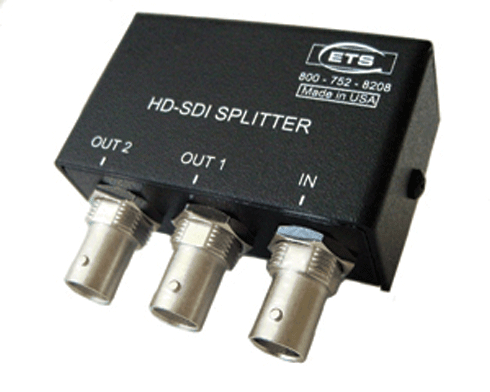
ETS PV991 HD-SDI Splitter. Image used with permission of the manufacturer, ETS.
Of course, you can use any Belden cable in and out of such a box and we now make six different sizes. In fact, this makes an elegant transition point. If you're using 1694A for long runs or our new 1794A for even longer runs, but those cables are too big by the time you're in the rack, this splitter can have one size coming in (like 1694A) and a much smaller size (1855A, for instance) coming out.
There are just a couple of cautionary notes here. If you don't use the other output, you need to put a 75 ohm terminator on that output. And that terminator should be 75 ohms out to at least 2 GHz. This splitter is good out to 2.5 GHz.
Remember, this is an impedance-specific splitter, so leaving one output floating will negatively impact the impedance of the other output. The second caution is that once you split the signal you are 3 dB down on each output and the insertion loss of the device itself, so you can't go as far on the output cables as you would on an single unbroken cable.
If you use our distance chart, the length of all the pieces: the input cable and the two output cables should add up roughly together to the distance on this chart. And this chart is ultraconservative, so you might even go farther.
Another clever use for this device is to use the second output as a monitor port, to be sure there is a signal going through the other cables and that it is an appropriate level and so on.
À propos de l’auteur
Steve Lampen
Responsable de la technologie multimédia
Steve Lampen, RCDD, a travaillé pour Belden pendant 25 ans, son dernier poste étant celui de responsable de la technologie multimédia et de la ligne de produits pour les produits de divertissement. En 2010, il a été nommé « Éducateur de l'année » par la National Systems Contractors Association (NSCA). En 2011, il a été nommé « Éducateur de l’année » par SBE. Son livre, The Audio-Video Cable Installer's Pocket Guide, a été publié par McGraw-Hill.