
What began as a single network to support voice and data has expanded into a network that still supports these systems, as well as wireless access points, access control, video surveillance, digital signage, LED lighting, nurse call systems and much more.
Many of these systems can function with longer reach (the devices will be more than 100 m away from a switch), higher Power over Ethernet (PoE) levels of up to 100W and 100% uptime and connectivity for data collection and sharing.
This means that your layer 0 must be able to manage multiple systems at once that all require more bandwidth and less latency.
If you have application-specific needs like these, you can use category cabling with a longer reach than what the standards call for (100 m).
Before you do so, however, there are a few considerations to keep in mind:
- Will the system use a specific switch or multiple types of switches?
- Will the extra reach still allow you to distribute power via Power over Ethernet (PoE)?
- Are you still meeting the insertion loss requirements set forth by IEEE?
Standards Required for Interoperability
The Ethernet Standard has been created and maintained by the IEEE 802.3 working group. For 10BASE-T systems, for example, the insertion loss of the data cabling system must be less than 11.5 dB at all frequencies between 5 MHz and 10 MHz.
For this same data cabling system to also deliver power, the DC loop resistance must be less than 25 Ohm. Having equipment that meets the IEEE 802.3 standard allows equipment from different vendors to be interoperable.
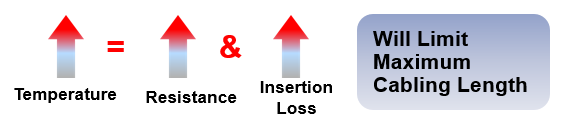
Insertion loss and DC loop resistance must be met for all environmental conditions. As shown in the figure above, as temperatures rise, the DC loop resistance and insertion loss will increase as well.
To make sure BASE-T and PoE systems perform as expected, the length of the data cabling is limited to ensure that insertion loss and DC loop resistance requirements are met at the standard operating maximum temperature, which is at least 60 degrees C.
Belden’s Recommendations
Following category cabling standards ensures interoperability, performance levels and ease of use; however, if you have a specific application in mind (like a 10/100BASE-T IP camera system that delivers PoE Type 2), Belden can offer Lifetime Application Assurance and a 25-Year Product Warranty using certain category cabling systems.
In this example, keep in mind that the installed system will not be upgradable to applications above 10/100BASE-T and PoE Type 2.
Designing a system like this requires a bit of engineering expertise – and that’s what Belden is here for. Have questions? Send us a message!
À propos de l’auteur
Ron Tellas
Architecte de solutions, Solutions d’entreprise, Belden
Ron Tellas est un expert en matière de conception des radiofréquences et de propagation électromagnétique, et a rejoint Belden en 2016 pour aider à définir la feuille de route de la technologie et des applications dans le bâtiment intelligent. Il met maintenant à profit sa vaste expérience pour intégrer des systèmes, des équipements et de la connectivité dans des solutions réseau. Ron représente Belden dans plusieurs organismes de normalisation et comités du National Electrical Code, et en tant que membre du conseil d’administration de la FMP Alliance. Il est titulaire d’un master et d’une licence en génie électrique et d’un master en administration des affaires, et est l’inventeur de 17 brevets américains. Ron est fier d'avoir reçu le prix Harry J. Pfister 2024 pour ses contributions exceptionnelles et significatives au secteur des télécommunications.